This year marks 35 years since the landmark Americans with Disabilities Act was signed into law, enshrining protections from discrimination to millions of people in the USA, while also creating more accommodations and educational opportunities than had been previously available.
One way that Galen College of Nursing is honoring the ADA and its impact across the nation is by working on building a culture of accessibility and inclusion.
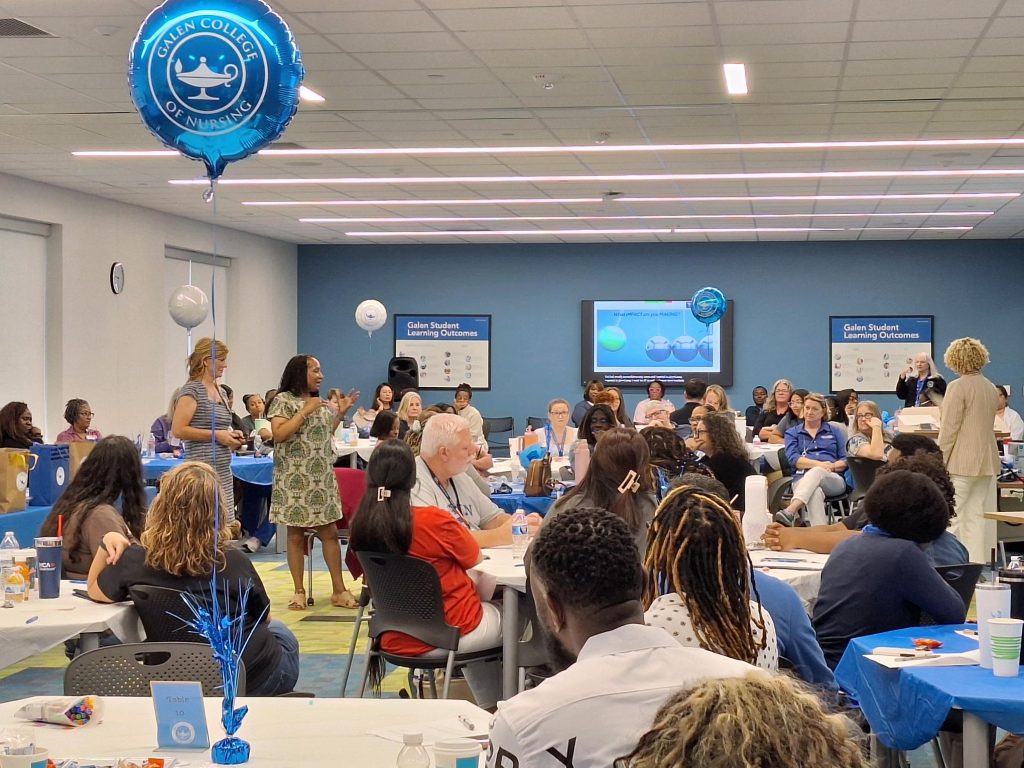
This was the theme at an event recently on Galen’s Houston, Texas campus attended by 138 faculty members and staff during an off week between terms. The event on accessibility and inclusion was hosted by Houston campus Dean Victoria Coyle, DNP, CHSE, RN and featured presentations from Associate Vice President of Culture and Engagement Carla McKenzie, PhD, MSN, RN, long-time nurse educator Dr. Janet Levy, as well as a panel discussion.
“In Building the Lamp, as one of the very first activities, we ask people to look at a photo and tell us what they see,” McKenzie said. “Some people see the ocean and the beach, and actually it’s the bottom of a rusty car. We challenge people to think differently. What Vicki and Laide did with this huge day was challenge and actually demonstrate the ability to think differently and provide a culture of belonging at their campus, and it was just impactful.”
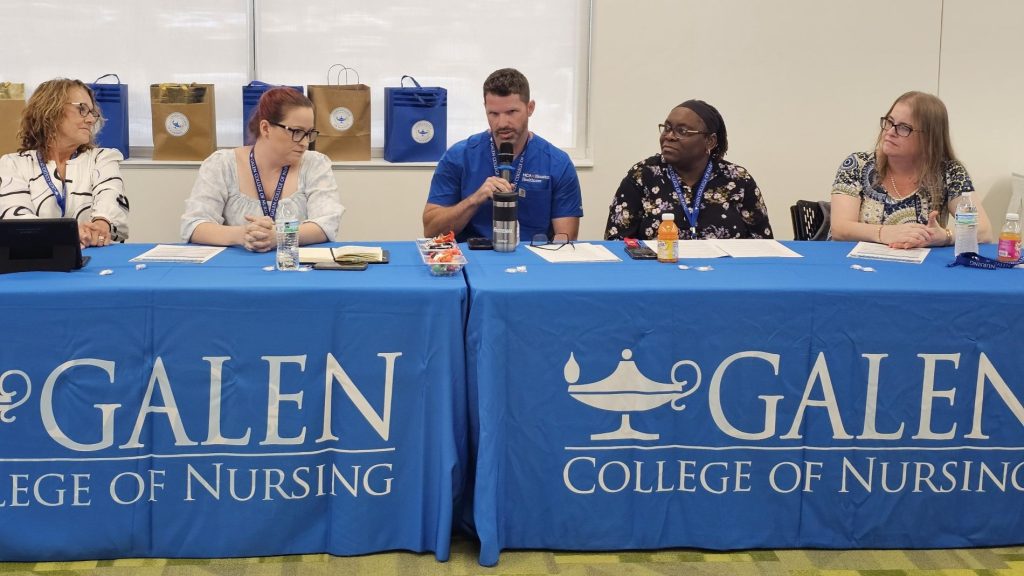
The panel featured Levy, two Galen Houston faculty members, Rachel Krogstie MSN, RN, and Oyindamola Adeoshun, MSN, BSN, RN, occupational therapist assistant Pamela Hartle, and HCA Houston Fairmont ER nurse Britton Phillips, RN. Levy and Adeoshun suffer from hearing loss, Krogstie was diagnosed with Autism and ADHD, Hartle was diagnosed with dyslexia (and she’s left-handed), while Phillips suffered serious injuries from a motorcycle accident in 2019.
One of the recurring themes from the panel discussion was that when given even a little support, the panelists were able to do amazing things. The support can be anything from allowing students to record lectures, using closed captioning, or providing extra time on tests.
There’s even been technological advancements that can help with accommodating faculty and students with disabilities.
We have iPhones now, they were able to connect my hearing aid to the iPhone so I don’t have to keep taking the hearing aid off and trying to turn up the volume to be able to hear,” Adeoshun said. “All those little things make a big difference, and being here at Galen, everyone is always willing to help, even my students.
At the same time, when teachers or advisors didn’t believe or support their students, it can make life much more difficult. Krogstie spoke about how she struggled to listen and take notes at the same time. She requested accommodations for the ability to record class sessions, as well as extra time on tests.
However, the director of nursing declined to approve these minimal requests, even going so far as to require documentation from a psychologist, psychiatrist, and physical therapist to prove that she was fit to practice nursing based on her cognitive intellectual disability.
I said to him, ‘I don’t have that. I have a learning disability that actually makes me pay attention more when I take my meds.’, Krogstie said, who went on to pursue her master’s degree and become a nurse educator at Galen. “I walked out of the office, went back to the accommodations departments of disability and told her ‘nevermind’. And I went through two years of nursing school with no accommodations because I refused to admit that I couldn’t practice nursing based on a falsity.”
On the other side, when a teacher takes the time to make a student feel included, and when an organization provides accommodations to raise equitability, great outcomes await.
Hartle shared a story about how her fourth-grade teacher helped her learn to write and spell words correctly on paper, allowing her to slow down instead of feeling like she was racing to keep up. She later went on to take AP classes in high school, and she reported maintaining a 4.0 GPA for both her undergraduate and graduate degrees.
“It can be done with the support and a lot of it is little things we don’t think about,” Hartle said.
Some of those little things can be part of universal design. As a left-handed person, Hartle used the example of a spiral notebook used to take class notes in – historically, the spiral has always been on the left side, which makes writing more difficult for left-handed people. Additionally, pens are often designed for right-handed individuals, and workspaces or desks are sometimes set up accordingly. But now you’re seeing some spiral notebooks where the spiral is at the top, or pens that work just as well for left-handed folks.

“These little things make things better because I live in a world that’s not made for me,” Hartle said. “That journey, that figuring things out, that’s what led me to occupational therapy. I’ve always had to adapt and modify my world, so when it came to a profession, that was the perfect one for me because I can adapt and modify.”
Levy talked about how she earned her master’s degree and doctorate degree, despite suffering from hearing loss and requiring the use of her service dog, an adorable pup named Gilly. While she had no accommodations available for her master’s degree program her doctoral program used closed captioning on lectures, among other accommodations, which helped her pass with flying colors.
“I am in clinical with the service dog, I’m in simulation labs with the service dog, academic classrooms with the service dog, and I just keep moving forward. I’m a role model. Don’t let what people think define you!”
At Galen College of Nursing, we believe every student deserves the opportunity to succeed. From classroom accommodations to inclusive technology and support, we’re committed to making our programs accessible to all. Explore how Galen supports students of all abilities and discover the resources available to help you thrive.

 Apply Now
  Request Information
  Contact Us (877) 223-7040