Skip to header Skip to content Skip to footer

Simulation Laboratory

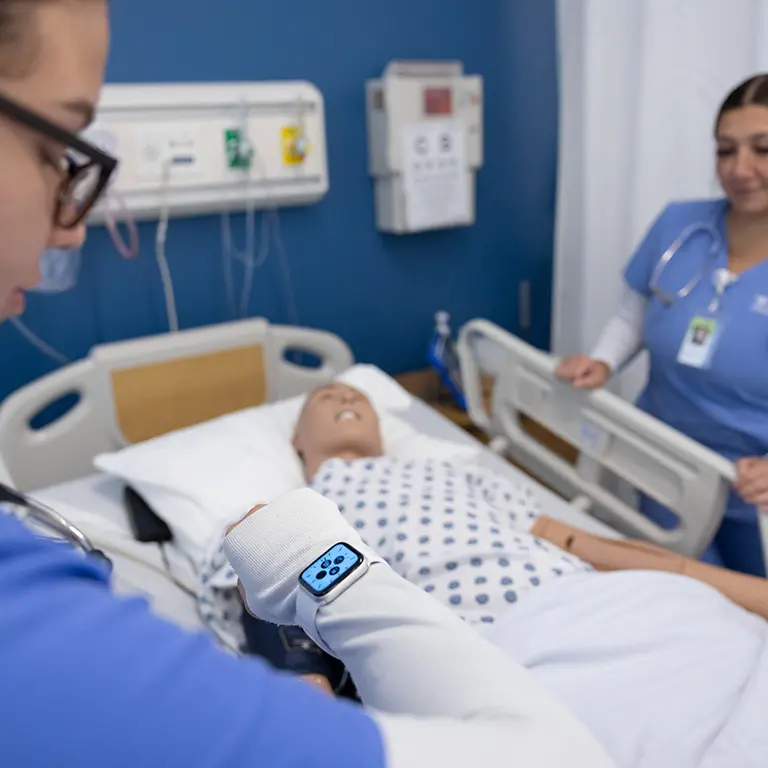
Galen nursing instructors and students gathered around a "patient" in the simulation lab

From Textbook to Practice: Hands-On Simulated Patient Care    

A safe way to practice care for patients, just as you will as a nurse.

Practicing nursing skills now will help prepare you for the nursing job ahead. Our simulation lab is the bridge between learning textbook techniques, applying them in clinical labs, and using them in real patient careIn the simulation lab, you’ll refine your skills and clinical judgment in an immersive environment where it’s okay to make mistakes—and learn from them.


Practice Means Progress in Every Pre-Licensure Program   

In the patient simulation lab, you’ll have the opportunity to get hands-on practice, such as taking blood pressure and vitals in a realistic hospital setting. These simulations are essential to every pre-licensure nursing program, and their inclusion in your curriculum helps build confidence and competency.   


Simulated Patients, Real Learning   

The heart of the simulation experience is our lifelike “patient” mannikins. They can blink, breathe, vocalize, and even react to medications, giving you a life-like experience handling the complexities of patient care. Some even talk!   

From checking their vitals to administering medications, you’ll interact with them just like you would with patients. These responsive mannikins allow you to experience how patients might respond, making your lab practice all the more authentic.   

You’ll encounter accurate physiological responses, such as:   

  • Heart, lung, and bowel sounds   
  • Chest movements and breathing patterns   
  • Reactive pupils and blinking   
  • Vocalizations and speech   
  • Connect the Classroom to Clinical Care   

While working with a patient, you’ll also learn to balance multiple tasks, communicate with your team, and stay adaptable as situations evolve—critical skills for the fast-paced and unpredictable nature of nursing.  


Challenging Scenarios for Every Skill Level

As you gain skills and move forward in your selected program, the scenarios become more challenging. This cumulative approach helps build your confidence, clinical judgment, and muscle memory, ultimately setting you up for success in your future nursing role.   


Solving Real-World Healthcare Challenges   

At Galen, we integrate patient scenarios into your clinical learning, creating a seamless connection between theory and practice. In the sim lab you will have the opportunity to care for patients from diverse backgrounds in various care settings.  Patients range in age from newborns to older adults experiencing a variety of problems that cannot always be guaranteed in the clinical setting.   

As you continue caring for simulated patients, you’ll improve your ability to adapt, solve problems on the fly, and work efficiently with your team. This hands-on approach ensures you’re prepared to tackle real-world healthcare challenges confidently. 

Is It Safe or Scary?

Confidentiality in simulation is the foundation of maintaining a safe learning environment.

Think of the sim lab as your safe space to practice patient care, learn from your mistakes, and become a better nurse. You won’t be criticized or embarrassed here. Instead, we mentor you and encourage you to grow and succeed.

Your patients are a variety of infant, child, and adult male and female human patient simulators. You provide care using the same types of equipment nurses use on the job. The human patient simulators can blink, breathe, laugh, cry—showing emotion like any other patient.

One female human patient simulator can give birth in an extremely realistic fashion. Galen scenarios help you practice for uncommon but critical perinatal events like pre-eclampsia.

In the clinical learning and simulation labs, you practice the same procedures you will as a nurse, such as:

  • assessing a patient
  • providing patient education
  • managing the nursing care of a deteriorating patient
  • inserting feeding tubes and catheters
  • reading heart rhythms
  • setting up IVs

One simulation lab day you might train in a labor and delivery situation, and another day in an ICU or ER. A typical simulation day lasts between four and eight hours, depending on the complexity of the simulation.

We design every simulation to feel as real as possible. You perform the procedures just like you would on a real person.

The high-fidelity simulators with a microphone have moulage, special effects makeup, bandages, or wounds as the scenario demands. There is no “pretend” here. If your “patient” is supposed to be bruised, you will see bruises.

To make things even more lifelike, your instructor speaks through the human patient simulator to communicate as a patient would. The condition of the human patient simulator improves or deteriorates, depending on the care you give them.

Students assume the role of nurse making independent clinical decisions during simulation experiences. Your class faculty watch from the control room while managing the simulation and noting your performance.

Immediately after the simulation, the whole class reviews the scenario and discusses choices, outcomes, and processes.

Many students say they learn equally from observing. Remember, once the review portion is complete, what happens in the sim lab stays in the sim lab!

3-Step Active Learning Approach

The pre-briefing session sets the stage for a controlled and secure learning experience. It consists of 2 stages:

  1. Preparation: Assignments to help you prepare for the simulation day.
  2. Briefing: Your sim instructor discusses your scenario.

You receive info on what to expect during the simulation, a review of the nursing care you’ve been learning about, and the simulation objectives. To avoid unnecessary surprises and reduce your stress, you’re told everything you need to know to set you up for success.

During the simulation scenario you and fellow students provide care to the simulated patient. Simulation experience encompasses all phases from pre-briefing through debriefing and evaluation. It is a high-quality, immersive experience that mirrors real events that you could meet in your future nursing career. The session is recorded so you can learn from watching yourself in action.

For some simulations, you work alone. For others, you work in a team. This replicates what you’ll experience in the field.

The sim lab is an extension of your coursework. It’s all those concepts, coming to life. Experienced nursing instructors supervise every simulation, and they offer you immediate and ongoing guidance.

You learn by doing—and by discussing. After the simulation ends, your instructor reviews the video and leads a structured debriefing session. The session is a round-table discussion with you and other students.

During the discussion, you receive constructive feedback and guidance. We guide you to find ways to improve or adjust your techniques for when you encounter a similar situation in the future. You collaborate with your peers to determine the best continuing care for this hypothetical patient.

The debriefing stage of the sim experience is a defining one. It recaps what you learned and reframes your responses. Over time, this helps you become a well-equipped and confident nurse.

youtube modal